
LED-Wall Color Correction — Following the Viewing Angle
Measuring why a camera never sees different colors based on the viewing angle and building a correction proposal.
In LED virtual production, the color a camera captures off an LED wall drifts depending on the camera's viewing angle. My bachelor thesis builds a matrix-based color correction that accounts for this angle, validated with spectrometer measurements and a Python pipeline.
Overview
My bachelor thesis, supervised by Prof. Dr. Jan Fröhlich at HdM Stuttgart. In LED virtual production, a camera films an LED wall displaying a virtual set — but the captured color drifts from the intended one, and that drift shifts strongly with the camera’s angle.
The Problem
LED panels aren’t Lambertian emitters — their luminance and color output change with viewing angle, which shows up as a measurable color error on camera. The thesis reconstructs a matrix-based correction method from the color-science literature and extends it with a viewing-angle-dependent component.
Measuring the Falloff
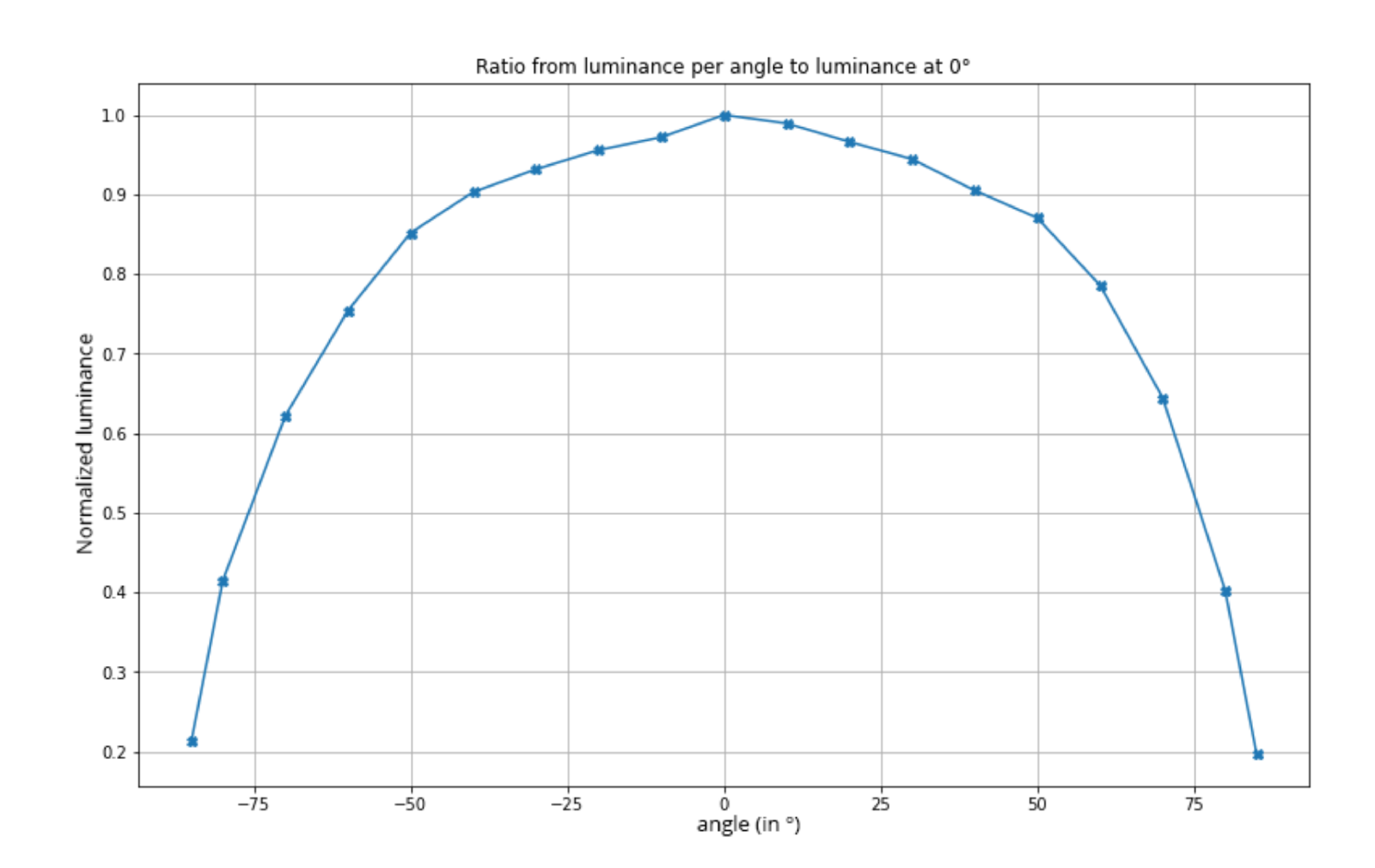
An LED panel was measured with a spectrometer across viewing angles from −85° to +85° on a turntable, with a Python pipeline computing correction matrices per angle and interpolating between them.